
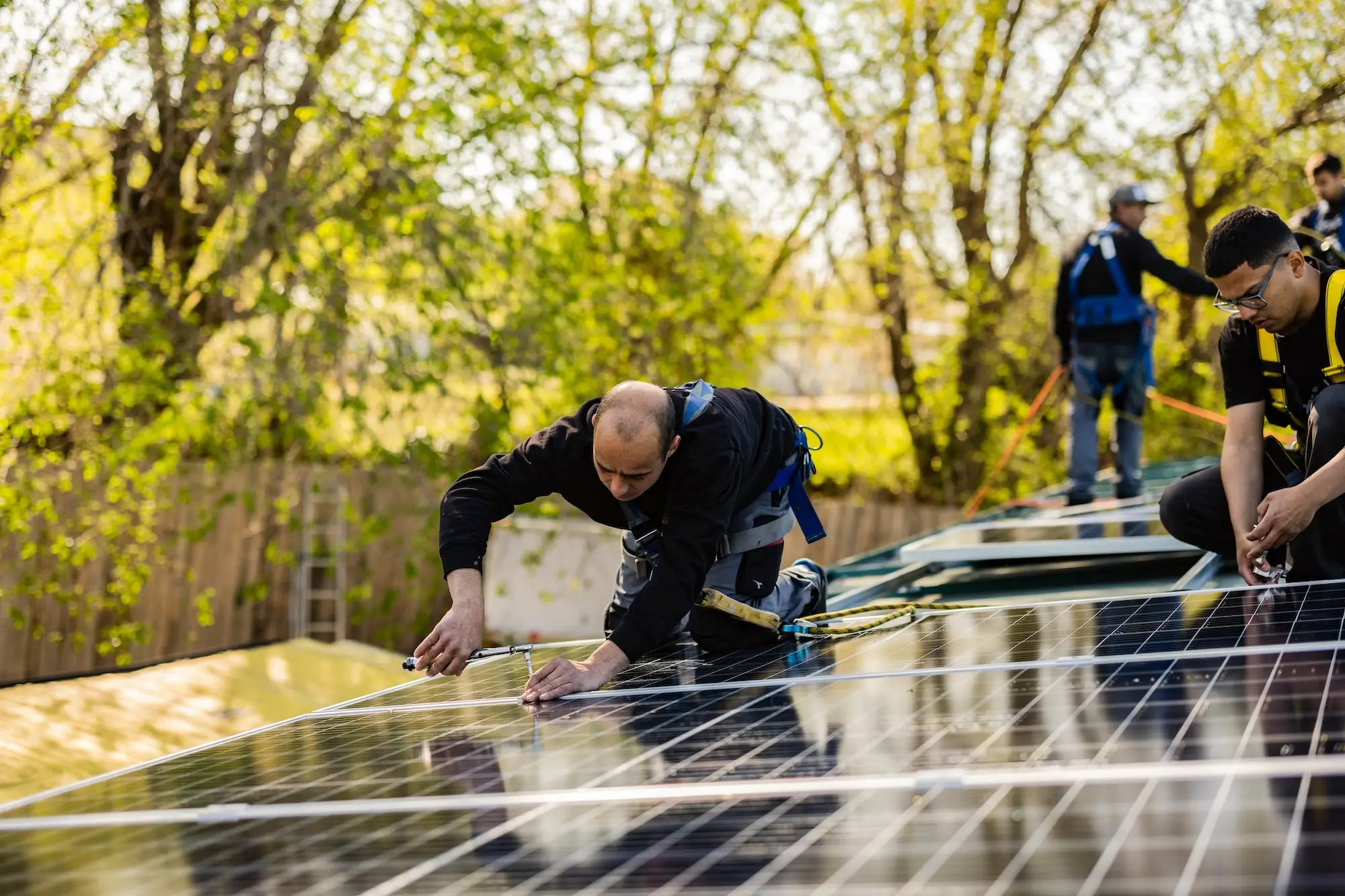
Some roofing companies can physically lift solar panels off a roof, but that doesn’t make them the right crew for the job. In Colorado, solar electrical work and the installation of panels and mounting hardware must be supervised on-site by a NABCEP-certified solar professional or a licensed electrician. Most roofers don’t have either on staff, so the safest setup is simple: a solar specialist removes and reinstalls your system, and your roofer replaces the roof in between.
Here’s why the split matters, what can go wrong when it’s skipped, and how to coordinate the two crews so your roof and your solar both come out protected.
Why Removing Solar Panels Isn’t Just a Roofing Job
A solar array looks like something bolted to the roof, but it’s a live electrical system. Panels produce DC voltage any time light hits them, even on a cloudy day and even with the inverter switched off. Taking them down safely means shutting the system down in the right order, disconnecting the wiring without damaging the connectors, and labeling everything so it goes back exactly as designed.
The roof side is just as technical. Every mounting attachment is a hole through your roof. When the system goes back on, each one has to land on solid structure and be flashed and sealed to your new roofing, or it becomes a leak waiting to happen.
A good roofer knows shingles, underlayment and flashing. A solar crew knows modules, racking, wiring and system commissioning. Detach and reset sits right where the two meet, which is why it goes best when each trade does its own part.
What Colorado Requires
Colorado law says solar electrical work, panel installation and mounting-hardware installation on most systems must be supervised on-site by one of these:
- A NABCEP-certified photovoltaic professional
- A licensed master electrician, journeyman electrician or residential wireman
Reinstalling panels is installation work, so the same rule applies to the “reset” half of a detach and reset. Many Colorado cities and counties also require a permit and an inspection before a reinstalled system can be turned back on.
If a roofing company offers to handle your solar, ask who will be supervising on-site and what certification or license they hold. If the answer is vague, the work is probably being done by roofers alone.
What Can Go Wrong When Roofers Handle It Alone
Most problems don’t show up on removal day. They show up weeks or months later, after the roofing crew is gone:
- Damaged connectors and wiring. Forcing connectors apart or letting cables drag across the roof can cause faults that cut production or create a shock or fire risk.
- Cracked panels. Panels can develop micro-cracks from being stacked, carried flat or stepped on. They may look fine and still lose output for years.
- Leaks at the attachments. Mounts reattached without proper flashing are one of the most common sources of roof leaks after a reinstall.
- Missing or mixed-up hardware. Racking parts are system-specific. Lost clamps or rails mean delays, substitutions or a reinstall that doesn’t match the original engineering.
- A system that won’t restart. Without commissioning and testing, you may not notice it’s underperforming until your utility bill climbs.
- Warranty trouble. Panel, inverter and workmanship warranties can be put at risk when unqualified crews handle the equipment. Check your warranty paperwork before anyone touches the system.
For a closer look at each step a solar crew follows, see How Does Solar Panel Removal and Reinstallation Work?
How to Split the Job Between Your Roofer and a Solar Company
There are two common ways to set it up. Either can work, as long as a qualified solar crew handles the panels.
| Setup | Who coordinates | Works well when | Watch for |
|---|---|---|---|
| Your roofer subcontracts a solar company | The roofer | You want one point of contact and one invoice | Ask the roofer to name the solar company and confirm its certification |
| You hire the solar company directly | You, with both crews talking | You want control over who handles your system and a direct warranty relationship | Agree on dates up front so panels aren’t off the roof longer than needed |
Either way, the order is the same:
- The solar crew inspects the system, documents its condition and shuts it down.
- Panels, wiring and racking come off and are stored safely, on-site or at the shop.
- Your roofer tears off and replaces the roof.
- The solar crew reinstalls the mounts with new flashing, then the racking, panels and wiring.
- The system is tested, inspected where required and turned back on.
If your roof replacement is part of an insurance claim, make sure the solar work is on the estimate before the roof starts. Our guide to whether homeowners insurance covers solar panel removal explains what to ask your adjuster.
Questions to Ask Whoever Moves Your Panels
- Who will be on-site supervising the solar work, and are they NABCEP-certified or a licensed electrician?
- Will you document the system’s condition and production before removal?
- Where will the panels and hardware be stored while the roof is done?
- How are the roof attachments flashed and sealed on reinstall?
- Do you pull the permit and handle the inspection?
- Will you test the system and show me it’s producing after reinstall?
- What warranty do you give on the reinstall work?
Wondering what all this costs? See How Much Does It Cost to Remove and Reinstall Solar Panels in Colorado?
Frequently Asked Questions
Can my roofer just unplug the panels and set them aside? Not safely. Panels stay energized whenever there’s daylight, and the shutdown, disconnection and reinstall all count as solar work under Colorado’s supervision rule. Your roofer can work around a solar crew, but the panels themselves should be handled by one.
Do I need to remove my solar panels to replace my roof? In almost every case, yes. Shingles and underlayment can’t be replaced properly under an array. See Do You Need to Remove Solar Panels for a Roof Replacement?
Should I hire the solar company myself or let my roofer handle it? Either works if the solar crew is qualified. Hiring directly gives you more control and a direct warranty relationship; going through your roofer gives you one point of contact. Ask for the solar company’s name and certification either way.
Can the company that originally installed my system do the reinstall? Often, yes, and it can be the simplest way to keep your workmanship warranty intact. If that installer is no longer in business or doesn’t do detach and reset, a qualified solar service company can take it on.
Planning a Roof Replacement? Let’s Get Your Solar Handled Right
Vanguard’s NABCEP-certified crews handle the full detach and reset: documenting your system, removing and storing it, reinstalling it with new flashing on your new roof, and testing it before we leave. We work directly with homeowners and with your roofing company, so the two jobs line up without gaps.
Request your free detach-and-reset estimate today or call us at 720-909-8899.
Related Articles: The Colorado Homeowner’s Guide to Solar Panel Removal & Reinstallation







Leave A Comment